-
72.WAR AS A PROFIT CENTER
What the Public Record Proves—and What It Does Not
COMMENTS FROM STREET TALK NETWORK ABOUT THIS POST-
1. Do your own research on the information provided and then come up with your own conclusions.
2. This article contains many names and other information that can be researched.
3. Trust your gut feeling on information provided as this post may contain slanted information.
Evidence-based report
September 4, 2026
September 2026
War as a Profit Center | Evidence Report
Executive finding
War is unquestionably an economic system as well as a military event. It transfers immense public funds to private contractors, increases government borrowing, raises arms demand, creates openings for corruption and illicit trade, and leaves mass death, displacement, family separation, and institutional collapse. Public records also establish particular cases in which U.S. covert operations moved weapons secretly, dealt with people or companies implicated in narcotics trafficking, failed to report drug allegations adequately, or subordinated drug enforcement to foreign-policy objectives.
The records do not, however, establish one all-purpose conspiracy in which the CIA systematically smuggles oil, gold, cash, guns, children, or organs for a unified class of “elites.” Nor do they establish that banks depend on war for liquidity, or that the United States has exactly 1,000 military bases under a single official definition. The strongest defensible conclusion is narrower and still serious: war creates legal profit centers and illegal shadow markets; secrecy, weak oversight, and strategic alliances have repeatedly protected or enabled corrupt actors; and some institutions benefit materially from continuing militarization.
Evidence grade at a glance
1. The legal war economy
The clearest evidence is not secret. Governments appropriate money; defense departments award contracts; arms and military-service companies earn revenue; investors receive returns; and lobbying helps shape future budgets.
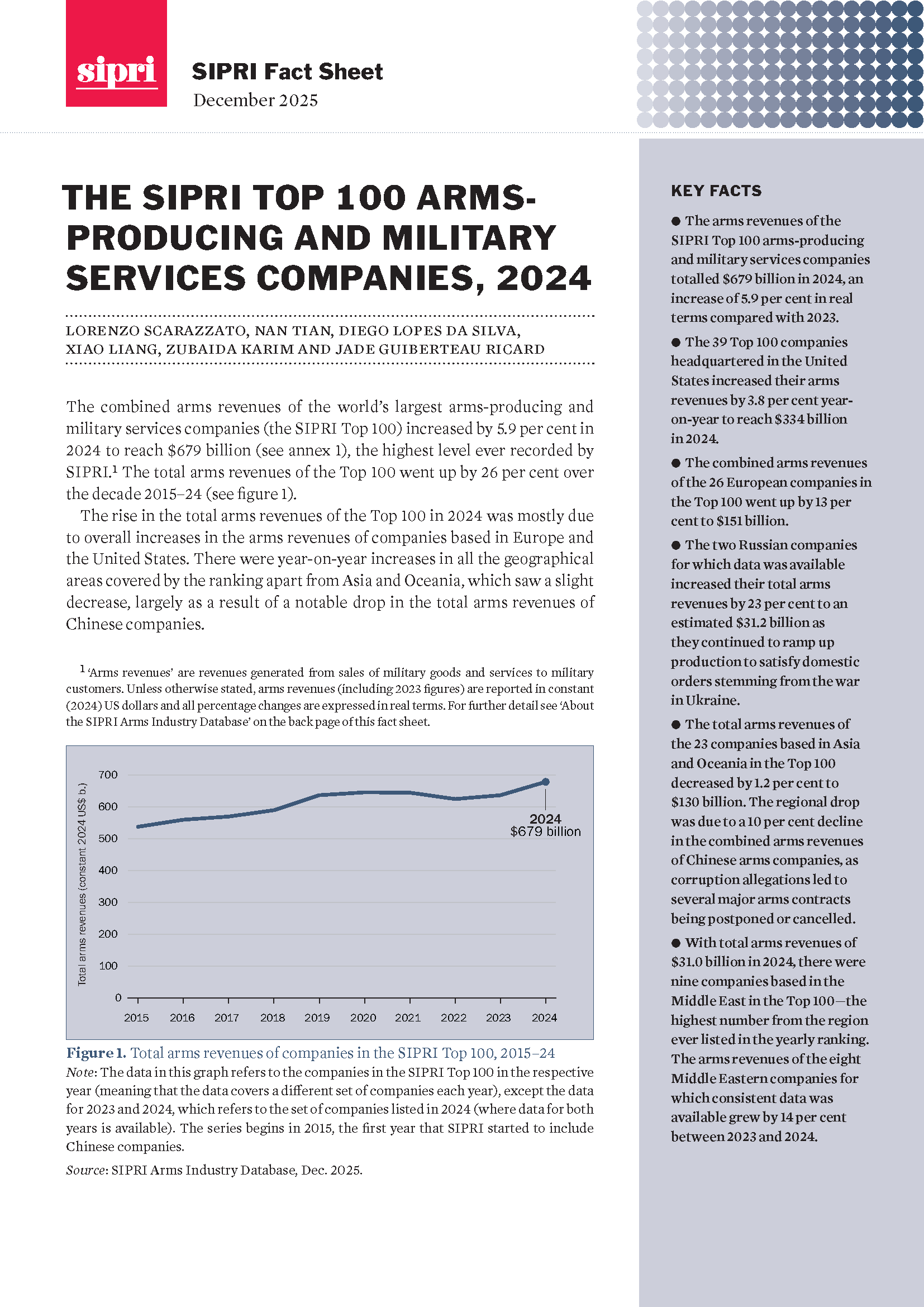
SIPRI reports that the world’s 100 largest arms-producing and military-services companies received $679 billion in arms revenue in 2024, a record, with U.S.-headquartered firms accounting for $334 billion. Its analysis directly links the increase to wars, regional tension, modernization, and expanding arsenals. SIPRI, *Top 100 Arms-producing and Military Services Companies, 2024*
The dependence runs both ways. Lockheed Martin’s 2024 annual filing reported that 73% of consolidated net sales came from the U.S. government and 65% from the Department of Defense; it warned investors that reduced defense spending could harm the business. Its 2024 net sales were $71.0 billion and net earnings $5.3 billion. Lockheed Martin 2024 Form 10-K, SEC and 2024 results filed with the SEC
Brown University’s Costs of War project calculates that, from 2020 through 2024, private firms received about $2.4 trillion in Pentagon contracts, approximately 54% of the department’s discretionary spending for those years. This is an academic policy estimate, not a government audit, but its methods and contract-based approach make it useful evidence of concentration. Brown Costs of War, *Top Beneficiaries of Pentagon Spending, 2020–2024*
This proves that war preparation and military spending are profit centers. It does not prove that every war is started only for profit. Wars also arise from ideology, territorial disputes, alliance commitments, security dilemmas, domestic politics, miscalculation, and leaders’ personal ambitions. Profit is a powerful incentive within the system, not a complete explanation for every decision.
2. Covert arms movement: Iran-Contra is proven history
Iran-Contra is the strongest documented example of a secret national-security network moving weapons and money outside the publicly stated policy. National Archives records describe clandestine U.S. arms sales to Iran, undertaken despite the administration’s public position, and the diversion of some proceeds to support the Nicaraguan Contras during a congressional prohibition on such aid. National Archives, Lawrence Walsh Iran-Contra records
The National Archives also summarizes the operational core: an aircraft carrying arms to the Contras was shot down in October 1986; reports then exposed covert arms sales to Iran; and profits from those sales were directed to the Contras despite Congress’s ban. National Archives, Iran-Contra program overview
This is an established example of officials and intermediaries using secrecy, proprietary or private logistics, foreign partners, arms transfers, and off-book funding to pursue policy. It supports concern about covert networks. It does not by itself prove that every later war or smuggling market is controlled by the CIA.
3. CIA, the Contras, and narcotics: the accurate conclusion
The documentary record contains two truths that are often wrongly treated as mutually exclusive.
First, the Senate’s Kerry investigation found substantial evidence that individual Contras, suppliers, pilots, mercenaries, and supporters participated in drug trafficking. It also found that foreign-policy objectives sometimes interfered with drug enforcement and that U.S. government funds went to companies or individuals implicated in trafficking. The Justice Department Inspector General’s history of the inquiry describes the 1,166-page Senate investigation and its focus on Contra-linked trafficking and government conduct. DOJ Inspector General, background to the CIA-Contra-crack review and DOJ OIG discussion of the Senate findings
Second, the later CIA and Justice Department Inspector General investigations did not substantiate the broad claim that the CIA directed Ricky Ross, Oscar Danilo Blandón, or Norwin Meneses, or deliberately created the crack epidemic in Los Angeles. The DOJ OIG found serious investigative and coordination shortcomings but called key newspaper claims exaggerated; it found little evidence that Ross and Blandón uniquely caused crack’s spread. DOJ OIG executive report and contents and DOJ OIG findings on the crack-distribution claim
The CIA Inspector General’s two-volume inquiry is especially important because its narrower exoneration coexists with extensive documentation of allegations and relationships involving Contra-connected people. Volume II examined CIA knowledge and handling of allegations across the broader Contra program. CIA Reading Room, Inspector General Report, Volume II and searchable reproduction of Volume II
The defensible conclusion is therefore:
Contra-associated networks included traffickers and persons accused of trafficking.
U.S. agencies sometimes continued relationships, contracts, or payments despite troubling information.
Reporting and interagency handling were inadequate, and foreign-policy priorities sometimes displaced drug-enforcement priorities.
The available investigations did not prove that the CIA centrally designed the crack epidemic or ran all Contra cocaine shipments.
This is not a clean bill of health. It is evidence of institutional tolerance, compartmentation, and failure—not proof of every maximal allegation.
4. Air America, Laos, and opium allegations
The CIA Reading Room contains records concerning allegations that Air America aircraft carried opium in Laos, including a document reporting the seizure of 400 pounds of opium aboard an Air America aircraft. CIA Reading Room, *Air America, Inc.—Alleged Smuggling*
Other released records state that Air America sought to prevent opium smuggling on its aircraft, illustrating the contested record: CIA holdings include allegations, internal responses, press clippings, and denials, not one conclusive institutional confession that the airline operated a centrally directed narcotics business. CIA Reading Room, Air America record
The historically careful finding is that U.S.-backed forces and allies operated within an opium-producing environment; aircraft and protected logistics created opportunities; allegations and some seizures were real; and oversight was compromised by covert-war priorities. The public documents do not establish that all Air America operations were an official CIA narcotics enterprise.
5. Why base counts differ
“Base” has no single globally accepted counting rule. The Pentagon’s Base Structure Report counts real-property sites, a term that can mean a large installation, a parcel, a small facility, or another property record. Its public library is the best starting point. Department of Defense, Base Structure Report library
The FY2024 inventory has been summarized as roughly 4,806 sites worldwide, the large majority inside the United States and its territories. An “approximately 1,000 foreign bases” estimate typically uses a broader independent method: it may count small cooperative-security locations, temporary deployments, classified or unlisted facilities, host-nation bases used by U.S. forces, and multiple sites near one installation. Conversely, official overseas counts often fall in the hundreds because they exclude or consolidate some of those categories.
Therefore, “the United States has about 1,000 overseas bases” is a reasonable advocacy estimate only if its method is stated. It is not a stable official fact. More precise language is: the United States operates an unmatched global network of hundreds of acknowledged overseas sites, with higher estimates when small, temporary, shared, and unacknowledged locations are included.
The existence of this network reflects many overlapping purposes—power projection, alliance commitments, deterrence, logistics, training, intelligence, and access. Its scale benefits contractors and can lower the practical barriers to intervention, but the base count alone does not prove that profit is the sole reason each facility exists.
6. Banks, war debt, and “liquidity”
War is commonly financed through taxes, borrowing, money creation, or some combination. World War II caused public debt ratios to surge in major industrial countries. Bank for International Settlements, historical discussion of wartime borrowing
Government bonds are central to modern finance. Banks and other institutions hold sovereign bonds because regulations treat many as high-quality liquid assets and because they serve as collateral in funding markets. BIS, *Sovereign debt markets—post-pandemic developments and challenges*
During World War II, U.S. policy explicitly facilitated Treasury debt placement through banks. Federal Reserve historical research notes that Congress exempted government war-loan deposit accounts from certain reserve requirements, temporarily increasing excess reserves and assisting new Treasury issues. Federal Reserve, historical study of reserve requirements
These facts establish a connection among war borrowing, sovereign debt, bank balance sheets, and collateral. They do not establish that banks need war to remain liquid. Central-bank reserves, deposits, interbank markets, repo markets, ordinary government borrowing, and central-bank lending provide liquidity in peacetime. The accurate claim is: war can expand public borrowing and financial intermediation, creating fees, interest income, and additional sovereign collateral; banks do not depend on war as a necessary source of liquidity.
7. Oil, gold, guns, and cash
Oil and gold
War does not create natural resources, but it changes who controls, taxes, sells, or smuggles them. Armed groups have financed themselves through oil, gold, diamonds, timber, and other commodities; governments and corporations can also gain strategic access or commercial opportunities.
UNEP reports that in Sudan, gold and other extractive resources have directly helped finance armed actors. In the Democratic Republic of the Congo, competition over gold, diamonds, cobalt, copper, timber, oil, and gas has fueled violence and corruption. UNEP on Sudan’s conflict and gold and UNEP on conflict and minerals in the DRC
In Iraq, oil revenues were the country’s core public asset, and war and sanctions created major opportunities for smuggling, corruption, and weak accounting. GAO found that Saddam Hussein’s regime obtained an estimated $10.1 billion in illegal revenue from 1997–2002, including $5.7 billion through oil smuggling and $4.4 billion through surcharges and illicit commissions. GAO, Oil-for-Food oversight findings
That finding proves conflict-related oil smuggling and corrupt revenue. It does not show that the CIA personally took Iraq’s oil or that the entire 2003 invasion was a theft operation. Motives, beneficiaries, and custody of revenues must be separated and documented case by case.
Guns
This is the most literal profit channel. Conflict consumes weapons and ammunition, prompts replenishment, and encourages states to expand capacity. SIPRI’s record 2024 arms-revenue figure and defense contractors’ own filings establish the scale without needing a secret theory.
Cash
War creates enormous cash flows through appropriations, emergency funds, procurement, security assistance, reconstruction, commodity sales, and illicit markets. Weak institutions and secrecy increase theft and diversion risk. But “cash” must be distinguished from profit: much wartime spending pays wages, transport, care, replacement, and reconstruction; some becomes contractor profit; some is stolen or wasted; and much becomes public debt that taxpayers service later.
8. Orphans, displacement, and exploitation
The human consequences are the least disputable part of the thesis. UNICEF reports record numbers of children living in conflict zones or forcibly displaced, suffering killing, injury, hunger, missed education, and separation from caregivers. UNICEF, children affected by conflict
UNICEF’s global data show 48.8 million children displaced by conflict and violence at the end of 2024. UNICEF Data, child displacement
War therefore creates orphans and separated children in the ordinary meaning: parents are killed, detained, disappeared, or separated during flight. These children are at elevated risk of trafficking, forced labor, sexual exploitation, forced marriage, illegal adoption practices, and recruitment by armed groups. UNICEF documents the use of children as soldiers, cooks, spies, messengers, and in other roles. UNICEF, children recruited by armed forces or groups
9. Body parts and organ trafficking
Trafficking for organ removal is a recognized crime. UNODC maintains legal and policy materials on trafficking in persons for organ removal and treats conflict, displacement, poverty, corruption, and weak institutions as vulnerability factors. UNODC compendium on trafficking in persons
But three propositions must not be collapsed into one:
Organ trafficking exists.
War makes vulnerable populations easier to exploit.
A centralized CIA/elite system harvests wartime bodies.
The first two are supported. The third is not established by the declassified or authoritative public record reviewed here. Individual allegations require named victims, medical records, transplant chains, financial records, court findings, or multiple independent investigations. Images of bodies, missing persons, or unexplained graves are not by themselves proof of transplant trafficking.
10. How elite benefit actually works
The documented mechanisms are often structural rather than cinematic:
Contracts and concentrated revenue: public money flows to a limited group of prime contractors and finance, logistics, technology, and reconstruction firms.
Lobbying and the revolving door: firms seek budgets and programs; officials and industry personnel circulate between government and contractors, creating conflicts of interest even without an explicit criminal agreement.
Privatization of risk and socialization of cost: firms receive payment while taxpayers absorb debt, veterans’ care, interest, reconstruction, and long-term instability.
Secrecy and emergency authority: classified programs, proprietary companies, emergency procurement, and limited congressional visibility weaken accountability.
Strategic partnerships with compromised actors: intelligence services may tolerate corruption or criminality by useful allies, assets, transporters, or armed groups.
Conflict commodities and money laundering: armed actors and politically connected intermediaries exploit oil, gold, drugs, weapons, and cash; financial institutions sometimes process the proceeds, knowingly or through deficient controls.
These mechanisms can produce elite enrichment without requiring a single command center controlling every war and every illicit market.
11. What FOIA and declassification can—and cannot—prove
FOIA releases are indispensable but easy to misuse. A document in the CIA Reading Room is not automatically a CIA admission. The collection contains finished intelligence, internal memoranda, allegations, congressional correspondence, newspaper clippings, drafts, and denials. Each item must be classified by authorship and purpose.
Reliable method:
Prefer inspector-general reports, court records, congressional findings, audit reports, contemporaneous operational records, and financial filings.
Distinguish “an agency possessed an allegation” from “the agency verified the allegation.”
Seek corroboration across institutions, dates, and document types.
Quote conclusions with their scope and caveats.
Treat redactions and missing files as evidence gaps, not automatic proof of the most incriminating theory.
Conclusion
The phrase “war is a profit center” is well supported if it means that military spending, arms sales, contracting, sovereign borrowing, reconstruction, and conflict commodities create large and concentrated revenue streams. The public record also proves specific covert abuses—most clearly Iran-Contra—and establishes that CIA-supported or U.S.-supported networks sometimes contained traffickers and that foreign-policy priorities weakened enforcement and oversight.
The evidence does not justify turning those findings into a universal claim that the CIA smuggles every valuable commodity for a unified elite, that banks cannot remain liquid without war, or that wartime organ harvesting is a centrally managed intelligence business. Overstatement makes the proven abuses easier to dismiss. The stronger case is the documented one: militarization creates recurring incentives, institutions, secrecy, and markets from which powerful actors can profit, while the costs fall disproportionately on civilians, service members, displaced families, and future taxpayers.
Core source gateway
CIA FOIA Electronic Reading Room
U.S. Department of Justice Office of Inspector General
National Archives Iran-Contra records
Department of Defense Base Structure Report library
Government Accountability Office
UNICEF conflict and displacement data
Limitations
This report evaluates major claim families and high-value sources; it cannot literally review “all websites” on the internet. Classified records remain unavailable, some releases are redacted, and the existence of a document in an archive may show only that an allegation was collected. Conclusions are therefore limited to what accessible evidence can support as of September 4, 2026.

sipri.org
The SIPRI Top 100 Arms-producing and Military Services Companies, 2024
The combined arms revenues of the world’s largest arms-producing and military services companies (the SIPRI Top 100) increased by 5.9 per cent in 2024 to reach $679 billion, the highest level ever recorded by SIPRI. The total arms revenues of … Continue reading