-
21.“REPORTED ARMY TEST DEATH PROMPTS SUIT TALK” — WHAT HAPPENED AFTERWARD
COMMENTS FROM STREET TALK NETWORK ABOUT THIS POST-
1. Do your own research on the information provided and then come up with your own conclusions.
2. This article contains many names and other information that can be researched.
3. Trust your gut feeling on information provided as this post may contain slanted information.
The Dallas Morning News article of December 24, 1976, concerned one of the most disturbing secret biological-warfare tests conducted over an American city. The contemplated lawsuit mentioned in the headline eventually became a federal wrongful-death case, but the Nevin family lost—not because the secret spraying was disputed, but because of causation and government-immunity barriers.
What the 1976 article reported
According to the Associated Press article, Edward J. Nevin III, a San Francisco attorney, had just learned that his grandfather, Edward J. Nevin, might have died following a secret 1950 military experiment. The younger Nevin reportedly called the discovery “incredible” and said that he, his brother James, and his sister Margaret Johnson were considering suing the federal government.
Nevin explained why litigation mattered to the family:
“But a lawsuit would have some value in getting the truth of this sorry episode into the open.”
The article noted that Edward J. Nevin was 75 years old and was recovering from prostate surgery at Stanford University Hospital—then located in San Francisco—when he developed an unusual infection involving Serratia marcescens. The bacterium entered his bloodstream and apparently reached his heart. He died in 1950.
The family had not previously known about the military release. They learned of the possible connection only after the secret testing became public in December 1976. A modern interview with Edward Nevin III confirms that he discovered the connection while reading the December 22, 1976, San Francisco Chronicle on a BART train. KQED’s detailed reconstruction
The secret test behind the controversy
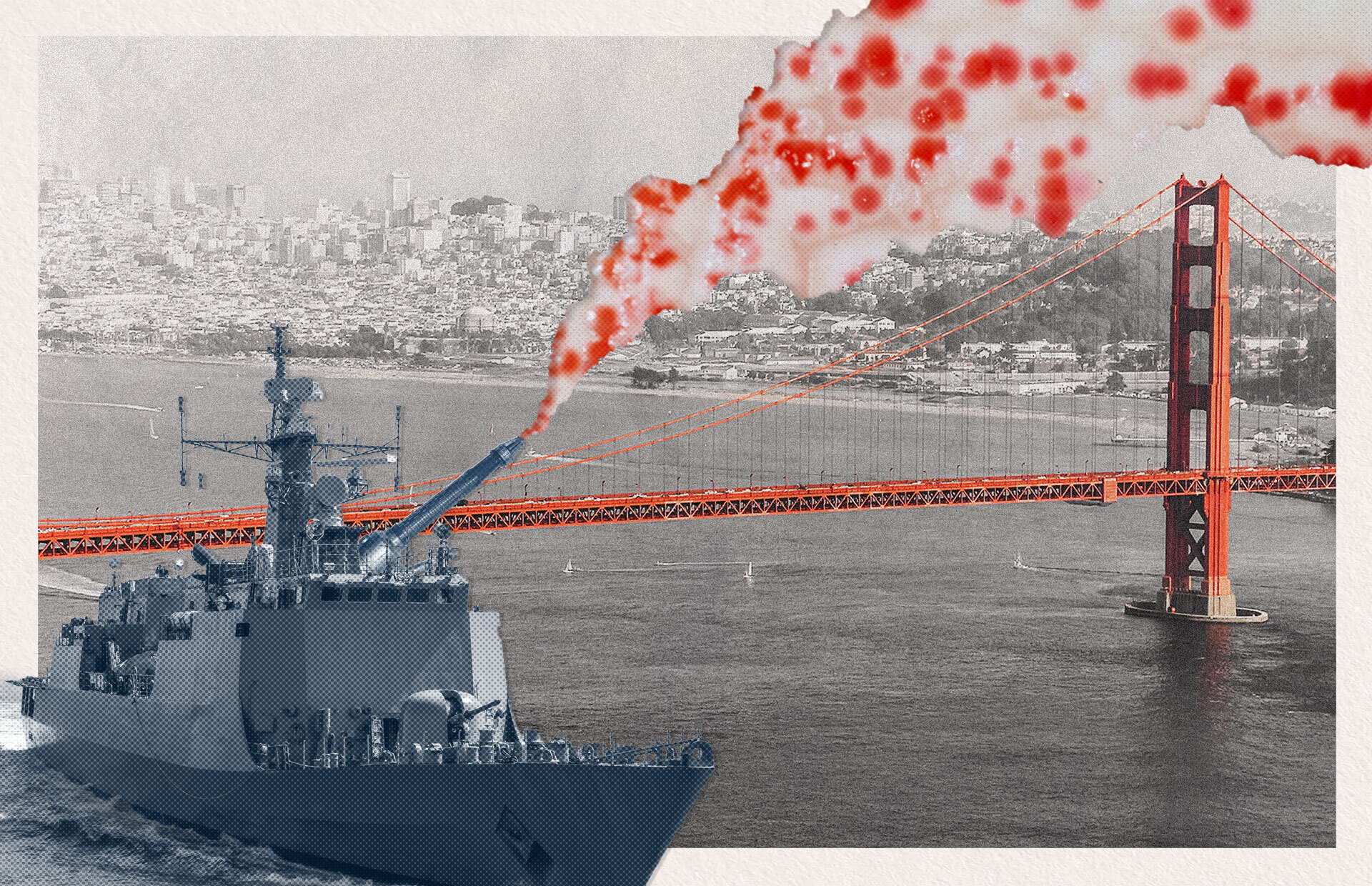
The operation is now generally called Operation Sea-Spray. It was planned under the Army’s biological-warfare program, while Navy vessels carried out the releases.
During September 1950, military personnel aboard vessels outside the Golden Gate released aerosol clouds containing:
- Serratia marcescens, strain 8UK
- Bacillus globigii, now generally classified as Bacillus
atrophaeus - Fluorescent particles used to help measure
dispersion
The bacteria were selected as biological-warfare “simulants”—organisms intended to behave like dangerous biological agents in the atmosphere while supposedly presenting little or no danger to people. Serratia was particularly convenient because many strains formed easily recognizable red colonies in laboratory cultures.
Air-collection equipment was positioned at 43 locations around the Bay Area. The military found that material released offshore could travel across San Francisco and as far as approximately 23 miles inland. Its report estimated that virtually every one of San Francisco’s approximately 800,000 residents could have inhaled thousands of particles per minute while the cloud remained airborne. The experiment demonstrated that an enemy could expose a coastal city to a biological agent released from a vessel offshore. Smithsonian Institution account
Residents were not informed, did not consent and were not medically monitored.
Edward Nevin’s illness
The timing produced the controversy:
1. Nevin entered Stanford Hospital for prostate surgery.
2. The military dispersed Serratia over the Bay Area in late September 1950.
3. Shortly afterward, Nevin developed a urinary-tract infection.
4. The organism was recovered from his urine and blood.
5. The infection spread and produced endocarditis—an infection involving the heart.
6. Nevin died.
Stanford physicians encountered a cluster of 11 patients with Serratia infections. The event was so unusual that Richard P. Wheat, A. Zuckerman and L. A. Rantz published a 1951 medical paper, “Infection Due to Chromobacteria: Report of Eleven Cases.” At that time, the organism was sometimes classified differently, but it was subsequently identified as Serratia marcescens. PubMed record for the 1951 medical report
The medical literature establishes that these 11 infections occurred and that one patient died. What it could not establish conclusively was how the bacteria entered the hospital or whether the organism infecting Nevin was genetically identical to the military’s strain. Modern genetic fingerprinting was unavailable, and the relevant cultures apparently were not preserved for later comparison.
Why the family considered suing
The 1976 disclosure raised several possible negligence claims:
- The government released live bacteria over an
unsuspecting population. - Military officials treated Serratia as
harmless despite evidence that some strains could act as opportunistic
pathogens. - No warning was given to hospitals or
public-health authorities. - There was no program to monitor illness after the
test. - The secrecy prevented Nevin’s doctors from
knowing that enormous quantities of the same species of bacterium had
recently been dispersed over the city. - The family did not learn enough to investigate a
possible government connection until approximately 26 years after Nevin’s
death.
The secrecy was especially important legally. Normally, a wrongful-death claim must be brought within a specified limitations period. The family’s position was that it could not reasonably have filed earlier because the government had concealed the experiment.
The lawsuit was eventually brought
The litigation became Mabel Nevin et al. v. United States. Edward Nevin III helped represent the family. Accounts differ on whether the initial filing should be described as occurring in 1980 or 1981, but the federal bench trial took place in 1981.
The plaintiffs proceeded under the Federal Tort Claims Act, which permits certain negligence suits against the United States. They argued that:
- The government negligently selected Serratia
marcescens for release over a populated city. - Military officials should have recognized that it
could cause disease, especially among hospital patients, elderly people
and others in weakened condition. - The released organism caused Nevin’s infection
and death.
The family presented scientific witnesses, including Harvard molecular biologist Matthew Meselson. Their case relied heavily on the coincidence of organism, place and time: a supposedly rare bacterium was sprayed over San Francisco, reached the area of Stanford Hospital, and appeared in an unusual cluster of hospital patients shortly afterward.
The government answered that:
- The strain was considered safe according to
scientific knowledge available in 1950. - Serratia
can occur naturally and within hospitals. - All 11 patients had undergone medical procedures
involving the urinary tract, supporting a possible hospital source. - No preserved cultures permitted a definitive
comparison between the Army’s 8UK strain and Nevin’s organism. - The decision to conduct the test and select its
organism was a protected governmental “discretionary function.”
Why the family lost at trial
Federal District Judge Samuel Conti ruled for the government on May 20, 1981. The court found that the family had not proven that the particular bacteria released by the military caused Nevin’s fatal infection.
That was the central scientific difficulty. The following facts made the family’s case plausible:
- The same bacterial species was involved.
- The outbreak followed closely after the releases.
- Serratia
infections were considered extremely unusual at the hospital. - The aerosol reportedly passed over the hospital.
But those circumstances did not conclusively exclude another source, such as contaminated hospital equipment, solutions, hands or urinary procedures. The district court therefore found causation insufficiently proven.
The court also concluded that the government was protected by the Federal Tort Claims Act’s discretionary-function exception. That provision preserves federal immunity for certain policy-level decisions, even when the discretion may have been abused.
The appeal produced an important disagreement
On January 17, 1983, the Ninth Circuit Court of Appeals upheld the government’s immunity position. The majority said that Chief Chemical Officer General Anthony McAuliffe personally authorized both San Francisco as the location and Serratia marcescens as the organism. Because the choice involved national security, secrecy, military requirements and medical risk, the majority characterized it as a protected planning decision.
The appellate court technically ordered the action dismissed for lack of subject-matter jurisdiction rather than simply entering judgment for the government. Full Ninth Circuit opinion: Mabel Nevin et al. v. United States
Judge William A. Norris dissented. He agreed that deciding to test San Francisco was a policy decision but argued that selecting a particular bacterium was an operational scientific and medical decision. In his view, courts were fully capable of deciding whether officials exercised reasonable care in choosing an organism for release over a city.
However, Judge Norris still would have upheld the result because he believed the district judge’s finding that the military bacteria had not been proven to have caused Nevin’s death was not clearly erroneous.
The family petitioned the U.S. Supreme Court, but on October 3, 1983, the Court declined to hear the case. That left the Ninth Circuit outcome standing.
What the ruling did—and did not—establish
The courts did not decide that Operation Sea-Spray never occurred. The government’s release of bacteria over San Francisco was established and admitted.
The courts also did not establish that the spray could not have killed Nevin. The narrower finding was that the family failed to prove, under the applicable legal standard, that the military strain caused his particular infection.
Nor was the decision a declaration that secretly exposing citizens was ethically acceptable. Much of the final outcome rested on sovereign immunity: the judiciary concluded that the Federal Tort Claims Act did not authorize the court to award damages for the protected planning decision.
Therefore, the most accurate conclusion is:
Edward Nevin may have died as a consequence of Operation Sea-Spray, and the timing and organism created a serious circumstantial case, but the causal connection was never proven conclusively in court.
The larger importance of the “suit talk”
Although the Nevins received no damages, their lawsuit served the purpose Edward Nevin III described in the 1976 article: it placed the facts before the public.
Because Federal Tort Claims Act cases are tried without juries, Judge Conti reportedly permitted journalists to occupy the jury box. National news organizations covered the testimony, government documents and history of the program. Decades later, Nevin III said that he did not truly expect to defeat the federal government but felt the family had to tell the story.
The case exposed three enduring problems:
- The military knowingly exposed an entire city
without consent. - Officials failed to establish medical
surveillance capable of detecting consequences. - The secrecy that protected the experiment also
made later scientific proof extraordinarily difficult.
That is the tragic irony behind the 1976 headline: when the family finally learned enough to talk about suing, the passage of 26 years—and the absence of preserved biological evidence—made proving their case far more difficult.

kqed.org
The True Story of the Military's Secret 1950 San Francisco Biological Weapons Test | KQED
Operation Seaspray was a military experiment that tested biological weapons over San Francisco in the 1950s. While meant to be harmless, the bacteria used may have killed someone.