-
22.DETAILED ACCOUNT OF “SLAUGHTER OF PRESIDENT KENNEDY (FROM FAREWELL AMERICA)”
COMMENTS FROM STREET TALK NETWORK ABOUT THIS POST-
1. Do your own research on the information provided and then come up with your own conclusions.
2. This article contains many names and other information that can be researched.
3. Trust your gut feeling on information provided as this post may contain slanted information.
4. It is my belief that this information is one of the most accurate postings on how President Kennedy was killed.
5. A lot of very interesting information in this article.
6. The links in blue are very interesting. Be sure to click on all links for more information.
The article titled “Slaughter (from Farewell America)” appeared in The Rebel on February 13, 1984. It is an excerpt from the controversial book Farewell America, first published under the name “James Hepburn.”
The article presents an elaborate conspiracy theory about President John F. Kennedy’s assassination. It does not merely argue that Lee Harvey Oswald had help. It claims that a ten-man assassination team—including four riflemen—prepared an ambush in Dealey Plaza and that government officials, particularly J. Edgar Hoover, possessed advance information about the plot.
These are the article’s allegations, not established historical findings. I will first explain exactly what the article says and then compare its claims with the official investigations.
The article’s proposed assassination team
According to “Slaughter,” approximately ten men participated directly in the Dealey Plaza operation:
- Four gunmen were assigned separate firing
positions. - Each gunman was accompanied or “covered” by
another operative, described as a spotter. - The supporting operatives allegedly protected the
gunmen, maintained radio communication and recovered their weapons. - A tenth man supposedly exercised overall command
and control of the operation.
The article does not name these alleged gunmen or identify the ten conspirators. It describes them as trained professionals and assigns them numbers rather than names.
That is a major evidentiary weakness: the article gives an extraordinarily detailed reconstruction of the conspirators’ planning and thoughts without explaining how its authors learned those details.
The firing positions
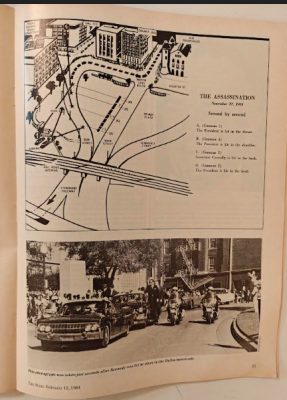
The accompanying map shows five numbered positions, although the text ultimately describes four active gunmen. The fifth position appears to have been considered and rejected or left unused.
Position No. 1: Near the railroad overpass
The first gunman was placed near the western end of Dealey Plaza, in the general direction of the railroad overpass or Triple Underpass.
The article says this position offered a relatively broad field of fire as the presidential limousine traveled toward the underpass. It alleges that Gunman No. 1 fired the first bullet that struck Kennedy in the throat.
This allegation requires a shot from the front. The official autopsy and both major federal investigations concluded that Kennedy’s neck and head wounds were caused by shots from behind. The Warren Commission reported that the shots came from the southeast sixth-floor window of the Texas School Book Depository. The House Select Committee on Assassinations also concluded that the two bullets that struck Kennedy were fired from behind. Warren Commission, Chapter 1, HSCA summary of findings.
Position No. 2: Farther west and close to the overpass
The article places Gunman No. 2 “beyond No. 1 and close to the railroad overpass.” It says Positions 1 and 2 provided approximately the same favorable angle as the limousine approached.
The article estimates that one of these positions offered a shot at a distance of approximately 100 feet. It assigns the fatal head shot to Gunman No. 2, allegedly firing from very close range as the car continued toward the underpass.
This is another front or front-side position inconsistent with the official medical conclusion that the fatal bullet entered the rear of Kennedy’s skull.
Position No. 3: Elevated location behind or beside the motorcade route
The map depicts Position No. 3 in the elevated building area on the north side of Dealey Plaza, apparently in or near one of the structures east of the grassy-knoll area.
The article assigns Gunman No. 3 the shot that struck Governor John Connally. It says this gunman also fired a second shot that missed.
Unlike the Warren Commission’s single-bullet conclusion, the article treats Connally’s wounds as having been caused by a bullet separate from the one that struck Kennedy.
Position No. 4: Building area behind the limousine
Position No. 4 was allegedly behind the presidential limousine, in the building area overlooking Dealey Plaza. The map appears to place it somewhere in the vicinity of the buildings east or northeast of the plaza rather than identifying it unambiguously as Oswald’s sixth-floor Depository window.
The article says Gunman No. 4 fired the bullet that struck Kennedy in the back. It alleges that this gunman later took a second shot but missed.
This is the shot in the article’s reconstruction that most closely resembles a bullet coming from the rear, although the article says it came from a Mauser rather than Oswald’s Mannlicher-Carcano rifle.
Position No. 5: Considered but apparently not used
The fifth marked position was regarded as less favorable. The text says the positions assigned to Gunmen 3 and 4 “offered less favorable positions” and describes another possible position from which the shooter could fire only during a narrowly calculated firing interval.
The article’s map includes a fifth location, but its final narrative consistently refers to only four participating gunmen. The reasonable reading is that Position No. 5 was examined during the alleged planning but rejected or used only as a contingency or observation point.
The article’s sequence of shots
The shooting reconstruction is the most important part of the article. It divides the attack into an initial volley and a second round of fire.
Initial volley: four shots
According to the article, all four gunmen initially fired:
1. Gunman No. 1 fired the first shot and struck Kennedy in the throat.
2. Gunman No. 4 fired the second shot and struck Kennedy in the back.
3. Gunman No. 3 fired and struck Governor Connally.
4. Gunman No. 2 fired, but the bullet allegedly passed through or struck a traffic sign between the gunman and the limousine.
Thus, in the first round described by the article:
- Four shots were fired.
- Three shots struck people.
- One shot missed the occupants of the limousine.
The three claimed human impacts were Kennedy’s throat, Kennedy’s back and Connally.
The authors say that the first shot was distinct, while later reports of three audible detonations supposedly resulted from the remaining shots being fired close together. In their theory, several shots were so closely spaced that witnesses interpreted them as fewer separate reports.
Second round: three more shots
The article then says that the limousine failed to accelerate after the opening gunfire. The writers claim that the gunmen were surprised because driver William Greer and lead agent Roy Kellerman did not react as quickly as the alleged planners expected.
As the limousine continued toward Positions 1 and 2:
- Gunman No. 2 allegedly fired the fatal shot into
Kennedy’s head. - Gunman No. 3 fired a second time and missed.
- Gunman No. 4 fired a second time and missed.
- The article does not clearly state that Gunman
No. 1 fired again.
A footnote expressly says:
“Positions 3 and 4 also took second shots, but missed.”
The article therefore describes seven shots altogether.
Therefore, the answer under the article’s own theory is:
- Four active shooters
- Seven shots fired
- Four shots hitting Kennedy or Connally
- Three shots missing the occupants
- Kennedy struck three times: throat, back and head
- Connally struck by one independently fired bullet
This differs sharply from the official findings.
Why the authors believed the limousine’s speed mattered
The article says the alleged planners carefully studied Kennedy’s limousine and calculated its normal motorcade speed at approximately ten miles per hour.
The turn from Houston Street onto Elm Street supposedly forced the limousine to slow to approximately eight miles per hour. The writers emphasize that this was an unusually favorable speed for marksmen firing at a moving target.
They also argue that the abrupt turn and the vehicle’s subsequent movement created predictable firing angles. According to the article, the gunmen were placed so that the limousine would enter overlapping “firing cones.”
The accompanying map attempts to illustrate:
- Each gunman’s line of fire
- The limousine’s changing position
- The distance from each firing point
- The points at which Kennedy, Connally and the
vehicle allegedly entered the different firing cones
The article portrays Dealey Plaza as a deliberately selected “crossfire” location.
The motorcade route allegation
A major part of the article concerns the change in Kennedy’s motorcade route.
It says Secret Service agent Winston Lawson met with Dallas Police Chief Jesse Curry and other officials before Kennedy’s arrival. They examined security around the Trade Mart and timed the route from Love Field.
According to the article, the motorcade could have proceeded more directly toward the Stemmons Freeway. Instead, it made:
- A turn onto Houston Street
- A very sharp turn from Houston onto Elm Street
- A slow passage through Dealey Plaza
- An approach toward the Triple Underpass
The authors characterize the Houston-to-Elm turn as contrary to normal Secret Service security practices because sharp turns force a presidential vehicle to slow down and expose it to surrounding buildings.
They insinuate that the route was selected to deliver Kennedy into the alleged firing zone. They also note that Dallas newspapers published incomplete or confusing descriptions of the motorcade route.
The article does not, however, establish that Curry, Lawson or the local officials intentionally selected the route to facilitate an assassination.
The article’s criticism of the Secret Service
The authors make several serious allegations about the conduct of the Secret Service:
- Agents were not riding on Kennedy’s rear bumper
when the shooting began. - The presidential limousine did not accelerate
immediately after the first shot. - Agent Roy Kellerman did not immediately cover
Kennedy. - Driver William Greer looked backward before
accelerating. - Agent John Ready allegedly attempted to move from
the follow-up car but was ordered back by agent Emory Roberts. - The protective response came only after the final
shots.
The article argues that the gunmen expected the agents riding on the back of the limousine to present a “human shield.” It says the conspirators took that possibility into account even though Kennedy reportedly had asked agents not to ride on the rear steps during certain motorcade appearances.
It suggests that the lack of an immediate response allowed the shooters time for the second round of fire.
The House Select Committee on Assassinations later reached a much less accusatory conclusion: Kennedy did not receive adequate protection, the Secret Service possessed information that was not properly analyzed, and its agents were inadequately prepared for a sniper attack. The committee did not find that the Secret Service participated in the assassination. HSCA summary.
The bubble-top discussion
The article emphasizes that Kennedy’s Lincoln limousine was traveling without its transparent “bubble top.”
Kenneth O’Donnell reportedly observed the clear weather and decided that the top would not be used. The authors acknowledge that the top was not bulletproof, but claim it might have:
- Deflected bullets
- Interfered with the gunmen’s view
- Made precise head shots more difficult
- Complicated the alleged crossfire plan
The article treats the clear weather as another factor that made the assassination possible.
The bubble top was primarily a weather shield. Assertions that it would necessarily have deflected the fatal shots are speculative.
The alleged weapons and ammunition
The article claims that the assassins used Mauser rifles without telescopic sights.
It argues that scopes would not have been necessary at distances of approximately 100 feet and that scopes require adjustment and careful handling. The authors say that unscoped rifles could have been more practical for rapidly following a slowly moving target.
They also claim that the gunmen used specially manufactured frangible bullets made from a lead-and-silver alloy. According to the article, these bullets were designed to break apart upon impact and leave less recoverable ballistic evidence.
No accepted official investigation found evidence that four Mauser rifles or lead-and-silver frangible bullets were used in Dealey Plaza. The physical evidence examined by the Warren Commission and HSCA linked the recovered rifle evidence to Oswald’s 6.5-millimeter Mannlicher-Carcano.
The article also discusses the AR-15 rifle carried in the Secret Service follow-up car, but it does not claim that this weapon fired Kennedy’s fatal shot. Its discussion is largely a critique of William Manchester’s description of the rifle’s power.
The article’s claims about J. Edgar Hoover and the FBI
The latter part shifts from reconstruction of the shooting to an accusation against FBI Director J. Edgar Hoover.
The writers claim:
- The FBI maintained an extensive network of
informants. - The FBI had approximately 75 agents in Dallas.
- Former FBI agent James Hosty was connected to the
investigation of Oswald. - Dallas officials and other people around the case
had FBI contacts. - By mid-October 1963, Hoover allegedly knew of a
plot and many of its details. - Reports from Boston, Chicago and Dallas
supposedly confirmed that something was being planned. - Hoover failed to give the Secret Service the
required warning. - Hoover avoided acting because of his political
hostility toward Kennedy and Attorney General Robert Kennedy.
The article quotes an FBI regulation requiring agents to send the Secret Service information indicating the possibility of an attack upon the president.
It then asks why Hoover did not intervene if the FBI knew about the alleged Dallas plot.
This is one of the article’s gravest allegations, but it is presented without documentary proof establishing that Hoover knew of this specific four-gunman plan. Later congressional investigations criticized the FBI’s handling of Oswald-related information and its post-assassination investigation, but the HSCA concluded that the FBI was not involved in Kennedy’s assassination.
The disputed claim that Oswald was an FBI informant
The article repeats the allegation that Lee Harvey Oswald had been on the FBI payroll as an informer since 1962. It attributes the allegation to Dallas District Attorney Henry Wade.
This story circulated shortly after the assassination, but official investigations did not substantiate it. The HSCA examined claims regarding Oswald’s possible intelligence relationships and found no credible proof that he was a paid FBI informant.
The article presents the allegation much more confidently than the available evidence justifies.
The package containing part of Kennedy’s skull
The article closes its main narrative with a disturbing account:
“The following day, November 23, the White House received a package sent over by his remarkable bureau. In it was a piece of President Kennedy’s skull.”
This appears to refer to the handling and delivery of physical or medical evidence following the assassination. The article uses the episode rhetorically, contrasting the FBI’s supposed failure to prevent the murder with its ability to send evidence to the White House afterward.
The article does not provide enough supporting documentation on the page to verify the exact chain of custody or explain why such material would have been delivered to the White House.
Comparison with the official shot counts
The article’s seven-shot, four-gunman scenario is not the conclusion of either major official investigation.
The Warren Commission concluded that Oswald fired three shots. One missed, one passed through Kennedy and struck Connally, and the last fatally struck Kennedy’s head. Warren Commission, Chapter 3.
In 1979, the HSCA concluded that Oswald fired three shots and that the second and third struck Kennedy. Relying heavily on acoustical analysis, it also found a high probability that a second gunman fired one additional shot from the grassy knoll, but that shot apparently missed. It therefore said Kennedy was “probably assassinated as a result of a conspiracy,” while finding insufficient evidence to identify the second gunman or the conspiracy. HSCA findings.
The acoustical conclusion has remained heavily disputed; even members of the committee noted that experiments with the police recording produced varying interpretations. HSCA member views and dissent.
Overall assessment
“Slaughter” is important as an example of the detailed multi-shooter theories that circulated after Kennedy’s assassination. Its major propositions are:
- Dealey Plaza was deliberately chosen as an ambush
site. - The motorcade route and slow turn onto Elm Street
created the firing opportunity. - Ten operatives, including four gunmen, executed
the attack. - Seven shots were fired.
- Four bullets struck Kennedy or Connally.
- Three bullets missed.
- Kennedy was hit from both the front and rear.
- Secret Service inaction permitted a second round
of fire. - The FBI knew of the conspiracy in advance.
- Hoover failed to warn the Secret Service.
- The FBI later directed attention toward Oswald.
The article gives a precise narrative, but precision is not the same as proof. It identifies no named gunmen, supplies no authenticated operational documents, establishes no chain of evidence for its inside information, and contradicts important medical and ballistic findings. Its account should therefore be described as a four-gunman conspiracy theory advanced by Farewell America—not as a proven reconstruction of the assassination.

archives.gov
Chapter 1: Summary and Conclusions Have a question about JFK Assassination Records? Ask it on HistoryHub! Introduction Narrative of Events Conclusions Recommendations Page 1 THE ASSASSINATION of John Fitzgerald Kennedy on November 22, 1963, was a cruel and shocking act … Continue reading

- Four gunmen were assigned separate firing